Post-quantum infrastructure company QuFi Network has launched a verification platform designed to protect digital assets against future quantum computing threats without requiring changes to existing blockchain settlement networks.
The platform separates verification from settlement, using a decentralized network of nodes to validate transactions with post-quantum cryptography before they are settled on existing blockchain networks.
QuFi also launched uBTC, a proof-of-concept that applies the verification system to Bitcoin (BTC) and is currently operating on Bitcoin Testnet4. The uBTC system verifies BTC collateral and generates cryptographic proofs governing how value moves between settlement environments, while redemptions ultimately settle as standard Bitcoin transactions.
The platform uses three post-quantum cryptographic standards — ML-DSA-65, SLH-DSA and ML-KEM-1024 — for digital signatures and secure key exchange.
QuFi said the external verification layer is intended to avoid the added storage, bandwidth and computing demands that can come with adopting larger post-quantum signatures directly on individual blockchains.
Related: Crypto’s first quantum attack will look like unexplained breach: Quantus founder
Crypto ramps up quantum defenses
The platform arrives amid a series of recent efforts to prepare blockchain networks for potential quantum computing threats.
In August, StarkWare tested a quantum-resistant Bitcoin transaction on mainnet without requiring a fork. However, the transaction took hours of computation and cost roughly $150 to $200, and its nonstandard format required direct submission to a miner.
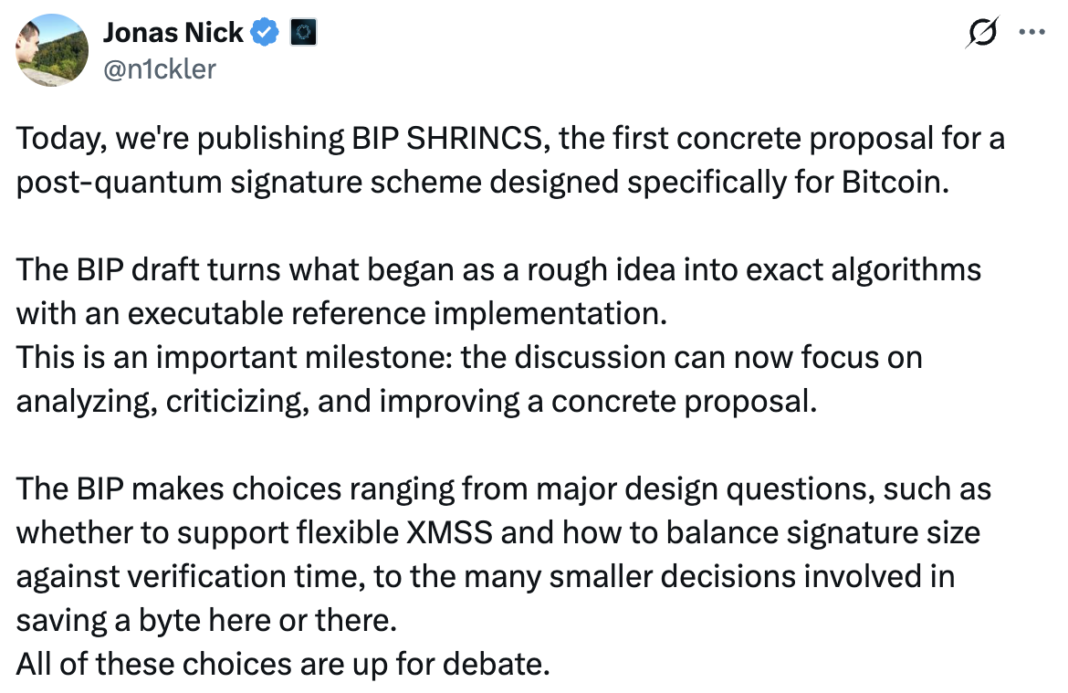
Jonas Nick announces the BIP SHRINCS proposal on Aug. 26. Source: Jonas Nick
The same month, banks and regulators across Europe, the Middle East and Asia joined a pilot testing post-quantum wallets and onchain transfers using ML-DSA-65, one of the same cryptographic standards incorporated into QuFi’s platform. Meanwhile, the Ethereum Foundation dropped the Poseidon hash function from its planned post-quantum architecture in favor of established alternatives such as SHA or BLAKE.
Bitcoin developers are also exploring protocol-level defenses. In August, Blockstream researchers published a Bitcoin Improvement Proposal for SHRINCS, an experimental post-quantum signature scheme designed to reduce the size and performance costs associated with quantum-resistant signatures.
The approach comes with trade-offs. SHRINCS uses stateful signatures to reduce their size, requiring wallets to track previously used signing keys. The scheme remains in an early stage without a completed security proof, and its design adds complexity and potential user failure modes.
Magazine: Bitcoin’s new quantum defenses, 18.9M SOL cancelled: Hodler’s Digest