Buying a tokenized stock sounds as though it should be simple. You pick a company you know, buy a token representing its shares, and hold it in a digital wallet. The appeal is familiar stock investing with some of the convenience of crypto, potentially including trading beyond the hours of a traditional exchange.
Then you encounter a rule saying trading might have to stop for three months, and the idea of always-available stocks needs a little more explanation.
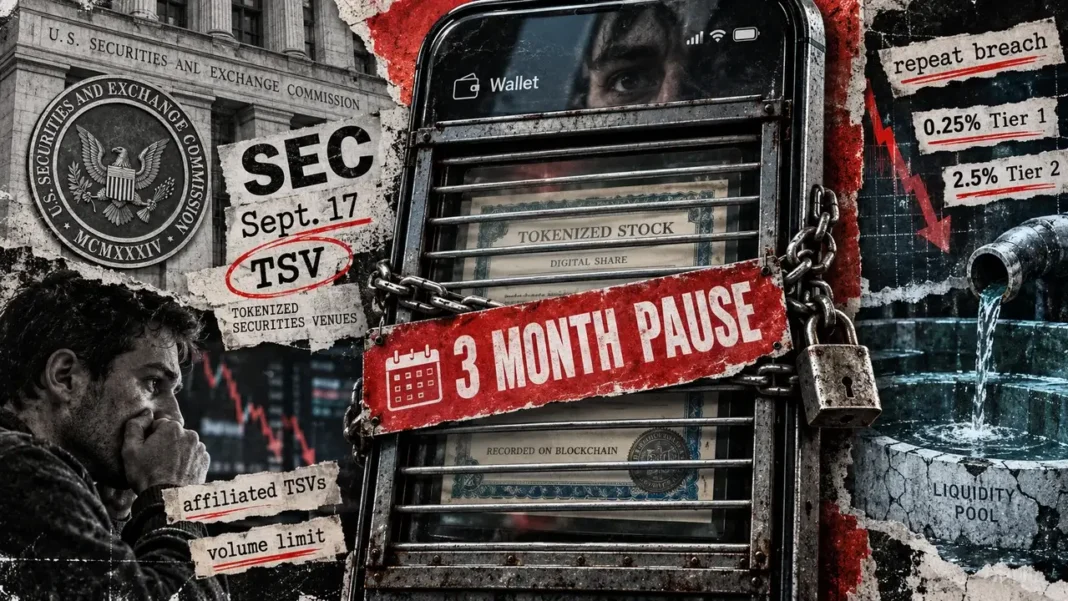
The pause is part of the SEC’s Sept. 17 framework for experimental Tokenized Securities Venues, or TSVs. Repeat breaches of a stock’s trading volume limit trigger it. It applies to that stock on the exchange and its affiliates, rather than to every version of that tokenized stock everywhere.
That distinction is a good place to start understanding the whole product. Owning a token, owning the rights attached to a share, and having somewhere to sell it are three related things that an app can make look like one.
Same company, different ways to own it
Stocks are already largely digital. Buying a share through a broker usually gives you an electronic record of ownership through a chain of financial institutions. Tokenization introduces a blockchain into how that ownership (or a claim related to it) is recorded and transferred.
The word “tokenized” describes the format, so you still need to know what the token represents. The SEC’s January explanation of tokenized securities separates several models. In one, a company or its agent uses blockchain records as part of its ownership system. In another, a third party holds shares and issues tokens representing an interest in them.
There’s also synthetic exposure, where the token gives you a financial return linked to a stock without giving you ownership of that company’s shares. Buying something that follows a company’s price doesn’t automatically give you shareholder rights.
CryptoSlate has covered stock tokens that don’t make their buyers shareholders. The lesson there is to look past the familiar ticker and find out who owes you what. If a separate company issues the token, its finances and obligations can become part of your investment risk alongside the business whose name attracted you.
The new SEC experiment takes a more specific approach. As CryptoSlate’s account of the framework explains, qualifying tokenized stocks must preserve the economic and governance rights of their traditional equivalents, including dividends and voting, and synthetic exposure just doesn’t qualify. Access to the exchange is permissioned, meaning participants or their wallets must meet verification standards.
Within those boundaries, the regulator is allowing a five-year test of trading through automated market makers. That sounds technical, but the basic idea is pretty simple: instead of matching your order with another person’s order, software lets you trade against a pool of assets supplied by other participants.
In a simple pool containing stock tokens and a payment asset, buying stock takes tokens out and adds payment assets. The pool’s formula adjusts the price as its inventory moves. Uniswap’s explanation of liquidity pools describes this general design, although different exchanges can use different formulas and arrangements.
The attraction is a trading system that can operate automatically and connect with other compatible financial software. But software still needs assets available to trade, legal rights behind the tokens, and, most importantly, people willing to supply capital.
How the three-month clock starts
The experiment has limits on both the number of stocks an exchange can offer and how much it can trade in each. The volume allowance is measured against activity in the traditional stock market, using average daily share volume.
The two categories have different limits, summarized in CryptoSlate’s coverage of the exemption. Tier 1 includes S&P 500 and Russell 1000 stocks and certain exchange-traded products; Tier 2 covers the other eligible securities.
| Stock category | Maximum symbols across affiliated exchanges | Per-stock volume threshold |
|---|---|---|
| Tier 1 | 75 | 0.25% of the traditional stock’s prior-month average daily share volume |
| Tier 2 | 250 | 2.5% of the traditional stock’s prior-month average daily share volume |
The SEC order’s volume-limit section compares average daily tokenized trading with average daily traditional trading, and combines affiliated exchanges’ activity. This is an average-volume test, so a single busy session isn’t automatically a breach.
Suppose the traditional stock averaged 10 million shares a day in the previous month. The Tier 1 allowance would correspond to 25,000 shares in average daily tokenized volume. That’s the comparison to keep in mind, rather than a fixed dollar amount or a limit on how much one customer can own.
The consequences escalate:
- The first volume breach for a particular stock gets a grace allowance, with the exchange required to ensure future compliance.
- Each later breach in that stock requires an immediate three-month trading pause, including at affiliated TSVs. The clock runs from the breach date. Other stocks can keep trading.
- Exchanges can pause earlier to avoid breaching the threshold. They must notify participants immediately of either kind of volume-related pause and update their public notice within five business days.
The SEC’s stated reason for keeping activity small is to limit risks to the wider stock market while it observes the experiment, including the possibility that pool prices diverge from traditional share prices.
You can see how that could happen in a simplified example. Suppose a pool has limited inventory and several customers want to buy at once. Its formula can push the token’s price upward even when the wider market’s view of the company hasn’t moved by the same amount. Traders may be able to profit by bringing the prices back together, but doing so depends on available capital and workable routes between markets.
The regulator is putting a boundary around how large that experiment can become. Crossing it repeatedly carries a substantial operational cost, which gives exchanges a reason to control activity before they reach the limit.
Owning tokenized stocks and selling them are different jobs
The buyer’s biggest practical concern is how to get out. Consider someone who buys a tokenized share intending to sell if they need the money for a repair: the trading pause could disrupt that plan even while they continue to own the asset.
Moving a token to another wallet wouldn’t, by itself, solve the problem. They’d need an eligible place to trade that exact instrument or a workable redemption process under its terms. Whether either exists depends on the product, the institutions supporting it, and the permissions involved.
The three-month provision shouldn’t be seen as a promise that another broker will accept the token, or as a universal prohibition on every possible transfer. Those are separate product-level issues, and buyers need actual answers rather than assumptions based on how easily ordinary tokenized stocks can sometimes move between apps.
This is also why the promise of longer trading hours deserves a second look. Being able to open an app at midnight says nothing about the price at which you can sell a meaningful position. SEC Commissioner Mark Uyeda addressed that trade-off at the agency’s 24-hour trading roundtable, noting that additional hours have an almost equal chance of distributing liquidity more evenly and spreading it too thin.
Before buying, the most revealing information would be a worked example from the provider: what happens to this token if this exchange stops trading it? That answer should explain custody, ongoing shareholder rights, permitted transfers, any redemption route, and the costs involved. It should also distinguish what the provider offers now from what it hopes to support later.
There’s plenty to like about making shares easier to transfer and connecting ownership records with trading software. Those improvements could remove delays and make financial services more convenient. The SEC’s initial five-year opening gives firms room to test that proposition.
The three-month pause brings the buyer back to an ordinary investing consideration: an asset needs a dependable route to sale. Until you understand that route, seeing a stock in your wallet tells you only part of what you need to know.