Bank-owned US payments operator The Clearing House has chosen Quant to supply software for a planned network for tokenized bank deposits.
The September 24 deal gives Quant a role in moving digital representations of bank deposits between institutions, but it doesn’t address whether those transactions require Quant’s QNT utility token.
QNT registered an intraday high of $373 on Sept. 27, but retraced heavily on Sept. 28, registering an intraday low of $195.35 before rebounding.
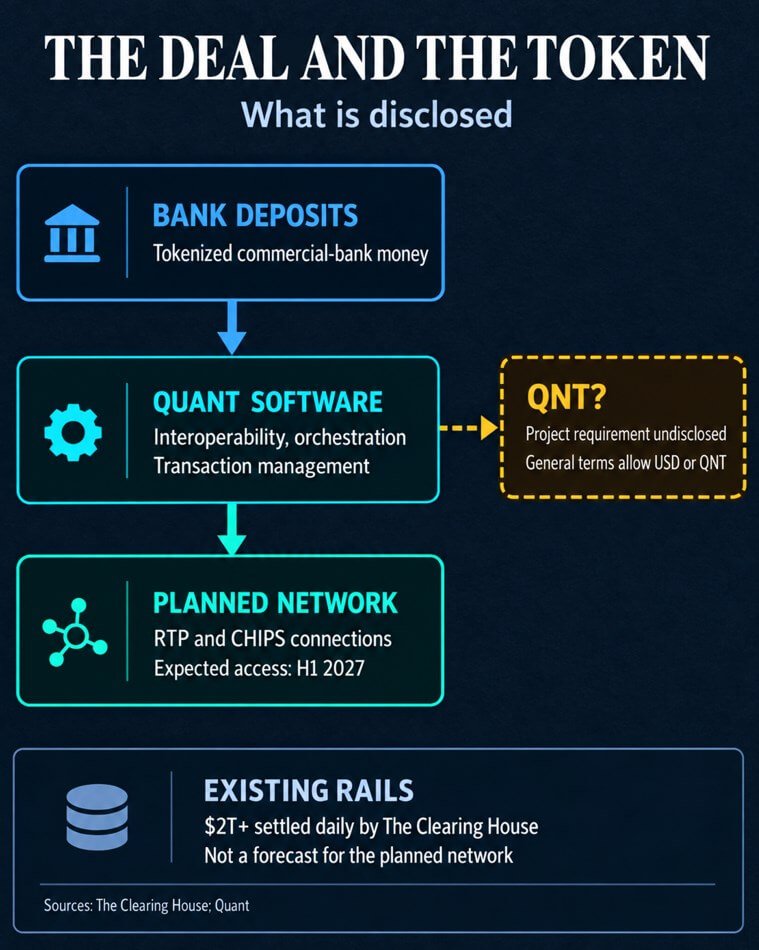
What Quant will provide
The Clearing House announced its On-Chain Money Initiative in June as a way for banks to clear and settle tokenized commercial-bank deposits across institutions. Unlike a publicly issued stablecoin, a tokenized deposit remains a claim on the issuing bank.
The planned network would connect this activity to established fiat payment systems, so bank money could move between on-chain and conventional infrastructure. The Clearing House says it aims to support immediate settlement and payments that trigger when agreed conditions are met.
On Sept. 24, The Clearing House selected Quant for the layer that connects systems, orchestrates activity and manages transactions. Its technology is also intended to link the network to RTP and CHIPS, two existing Clearing House payment systems.
Quant’s announcement described the same role and said it will offer Tokenized Deposits-as-a-Service to US institutions using The Clearing House that lack their own tokenized-deposit capability.
The network is expected to become available to participating institutions in the first half of 2027. Neither September announcement reports a live rollout nor names banks that have subscribed to Quant’s additional service.
A technology selection then provides no published schedule of transaction volume or service revenue.
Quant’s general terms define QNT as a utility token customers may use for Quant products and services. The Clearing House and Quant do not say that participating banks must acquire or hold QNT, pay a network fee in it, use it as a settlement asset, or burn it.
Banks backed the initiative when it was unveiled in June, before Quant was named. Their support for the network is not a disclosed commitment to buy QNT or subscribe to Quant’s bank-side service.
How a bank payment could reach QNT
Quant’s public payment options say fees may be agreed during ordering, shown on a subscription dashboard, or specified in an order form. Transaction fees can be paid monthly or annually in advance, with possible overage invoices.
The agreement allows card payment and invoices where Quant agrees. Although QNT is normally the only digital asset accepted for access to the Quant ecosystem, that condition leaves fiat payment open.
Quant’s FAQ explicitly says platform fees can be paid in US dollars or subscriptions can be made with QNT.
The announcements omit a rule tying a bank’s deposit transfer to a purchase or lockup of QNT. Revenue to Quant from selling software or services would be a separate proposition from demand for the utility token.
An older product description offers context for QNT’s role elsewhere in Quant’s business. A 2022 explanation of Overledger says transactions on that interoperability platform are powered by QNT, with fiat payment options for corporate customers.
Overledger is Quant’s technology for connecting different ledgers, and that explanation predates the bank-network selection by four years. The 2026 announcements do not specify whether its token mechanism applies to this implementation.
The Clearing House’s September release says existing wire, ACH, check-image and real-time-payment networks clear and settle over $2 trillion each day.
A defensible token-demand estimate would require a project-specific rule for QNT use, the fee or conversion mechanics, a forecast or observed volume on the new network, and clarity about who would source the tokens.
Disclosures on those points could change expectations for QNT demand. Until then, the selection supports Quant’s role in a planned bank infrastructure project while leaving the path from its future activity to QNT demand unresolved.