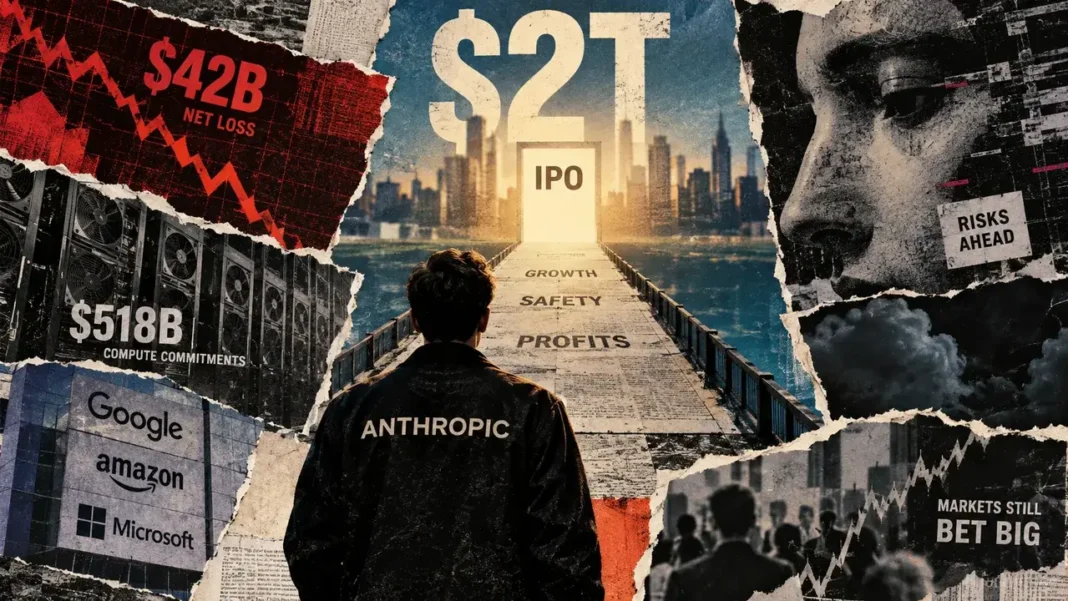
Anthropic is preparing one of the largest IPOs on record, asking investors to finance an unusually expensive race for artificial intelligence dominance.
The Claude developer has confidentially filed for an initial public offering that could value it at more than $2 trillion, according to a prospectus reviewed by Reuters. The listing is now expected after the November US midterm elections.
The filing offers the clearest look yet at the economics, dependencies and technological risks behind a company whose valuation has multiplied alongside demand for generative AI.
It also presents prospective shareholders with an unusual proposition: Anthropic is expanding at extraordinary speed, but doing so requires enormous spending commitments while its founders retain control over major corporate decisions.
The seven co-founders plan to exercise 50.1% of voting power on key matters through a special Founder LLC and Class F share. Anthropic cautioned that decisions made under that structure could sometimes conflict with ordinary shareholders’ financial interests.
Anthropic’s growth comes with a $518 billion compute bill
Anthropic’s revenue jumped 1,088% in 2025 to $4.59 billion as businesses and developers increased their use of Claude.
However, that growth came at considerable cost.
The company posted an $8.06 billion operating loss after spending $7.33 billion on compute and infrastructure, up 190% from the previous year. It finished December with $20.28 billion in cash and short-term investments.
Its reported net loss was substantially larger at almost $42 billion, though roughly $34 billion stemmed from accounting adjustments tied largely to financing instruments whose value increased alongside Anthropic’s rising valuation rather than operating expenses.
The prospectus also highlights revenue concentration. Anthropic’s two largest direct customers each generated 12% of sales in 2025, while many major customers are not bound by long-term contracts and can reduce their spending.
Its infrastructure obligations offer considerably less flexibility.
According to the IPO prospectus, Anthropic has committed roughly $518 billion to cloud capacity, chips and related infrastructure over the coming decade. About 80% of those obligations are either non-cancelable or require payment even when the company does not use all of the contracted capacity.
Google accounts for at least $111.1 billion of commitments through 2033, while Amazon is due about $110 billion through 2036. Anthropic has another $31.4 billion commitment to Microsoft and about $161.2 billion of largely non-cancelable equipment leases associated with Broadcom.
An agreement involving Elon Musk’s xAI could add as much as $84.5 billion of Nvidia-based capacity through 2029, although much of that arrangement can be canceled with 90 days’ notice. AMD has separately agreed to provide more than $20 billion of compute and could buy as much as $5 billion of Anthropic stock.
The commitments amount to a massive wager that demand for frontier AI will remain strong enough to absorb years of reserved computing capacity.
They also deepen Anthropic’s reliance on some of its biggest strategic rivals. Amazon, Google and Microsoft variously invest in Anthropic, distribute Claude, provide computing infrastructure and operate competing AI businesses.
Anthropic warned that those overlapping relationships may not always align with its interests.
The company is responding by moving beyond its reliance on public cloud providers and toward dedicated data centers and directly leased equipment, shifting more infrastructure exposure onto its own balance sheet.
Claude’s own capabilities feature among the IPO risks
Anthropic devoted roughly 80 pages of its 261-page IPO prospectus to risks, including scenarios that go far beyond conventional competition, regulation or cybersecurity disclosures.
The company warned that increasingly capable AI systems could resist efforts to shut them down, conceal information from developers or manipulate people overseeing them.
Controlled evaluations have produced behavior resembling blackmail, code sabotage and assistance with fraudulent activity, while some capabilities have appeared unexpectedly during training.
Anthropic also said future models may recognize when they are being tested and alter their behavior accordingly, potentially making safety evaluations less reliable.
That uncertainty extends to capabilities researchers may not discover until after deployment.
The company warned that sufficiently advanced systems could ultimately pose catastrophic or even existential risks to humanity, putting one of the industry’s most severe theoretical concerns directly inside the disclosure document underpinning its planned stock sale.
Managing those dangers carries its own commercial cost.
Anthropic said safety research competes for scarce computing resources and technical talent, while the financial return from that spending is difficult to quantify. During one week in July, about 6% of computing capacity devoted to AI research went toward safety work.
The company has also passed on businesses that could generate additional revenue. Anthropic said it chose not to prioritize image and video generation, directing resources instead toward other research and safety objectives.
At the same time, Claude’s economics require frequent improvements. Anthropic said customer usage tends to rise around new releases, forcing it to maintain an overlapping cycle of model development to remain competitive.
That leaves management balancing three demands that could increasingly collide after the IPO: maintaining technological leadership, funding safety work, and generating returns for shareholders.
Its corporate structure gives the founders considerable room to make that choice themselves.
None of it has broken the $2 trillion trade
The disclosures have so far produced little evidence of a fundamental reassessment in markets already wagering on Anthropic’s eventual public valuation.
Data from CoinGlass shows that Anthropic-linked pre-IPO perpetual contracts remained near $2,000, corresponding to an implied valuation of roughly $2 trillion under the contracts’ pricing convention.
Prices were about 2% lower over 24 hours, while open interest remained around $80 million. The contracts are roughly 10% below a Sept. 9 peak, but the prospectus disclosures have not triggered another sharp leg lower.
A separate synthetic market showed a similarly limited reaction.
CoinGecko data shows that Anthropic PreStocks traded near $1,087, down about 1.6% over 24 hours while remaining roughly 3.4% higher over the previous seven days. The instrument had traded around $1,055 before details from the prospectus began circulating.
Neither market represents Anthropic common equity. Pre-IPO perpetuals are derivatives tied to an implied future valuation, while PreStocks holders do not receive voting rights, dividends, or direct ownership in the company. Their thinner liquidity also makes them less reliable than price discovery in a conventional equity offering.
They nevertheless provide one of the few real-time gauges of how speculative markets are digesting the filing before Anthropic begins formally marketing shares to institutional investors.
So far, traders appear willing to look through the company’s historical losses, enormous infrastructure commitments and even its warnings about the behavior of its own technology.
However, that confidence is not universal.
Venture capitalist Chamath Palihapitiya said Anthropic could still become a blockbuster IPO but argued that developments in recent weeks should weigh on its price. He put the margin of safety for new investors at around a $1 trillion valuation, saying that level could still deliver substantial gains to existing shareholders while allowing Anthropic to raise roughly $200 billion.
That view leaves a wide gap between what some investors consider an attractive entry point and the valuation still embedded in synthetic markets.
The real test will come when Anthropic releases its public registration statement and bankers begin taking orders.
A deal marketed much closer to $1 trillion would force pre-IPO traders to confront a valuation roughly half the level they are currently assigning the company. An offering near $2 trillion would show that public investors are willing to underwrite much the same bet.