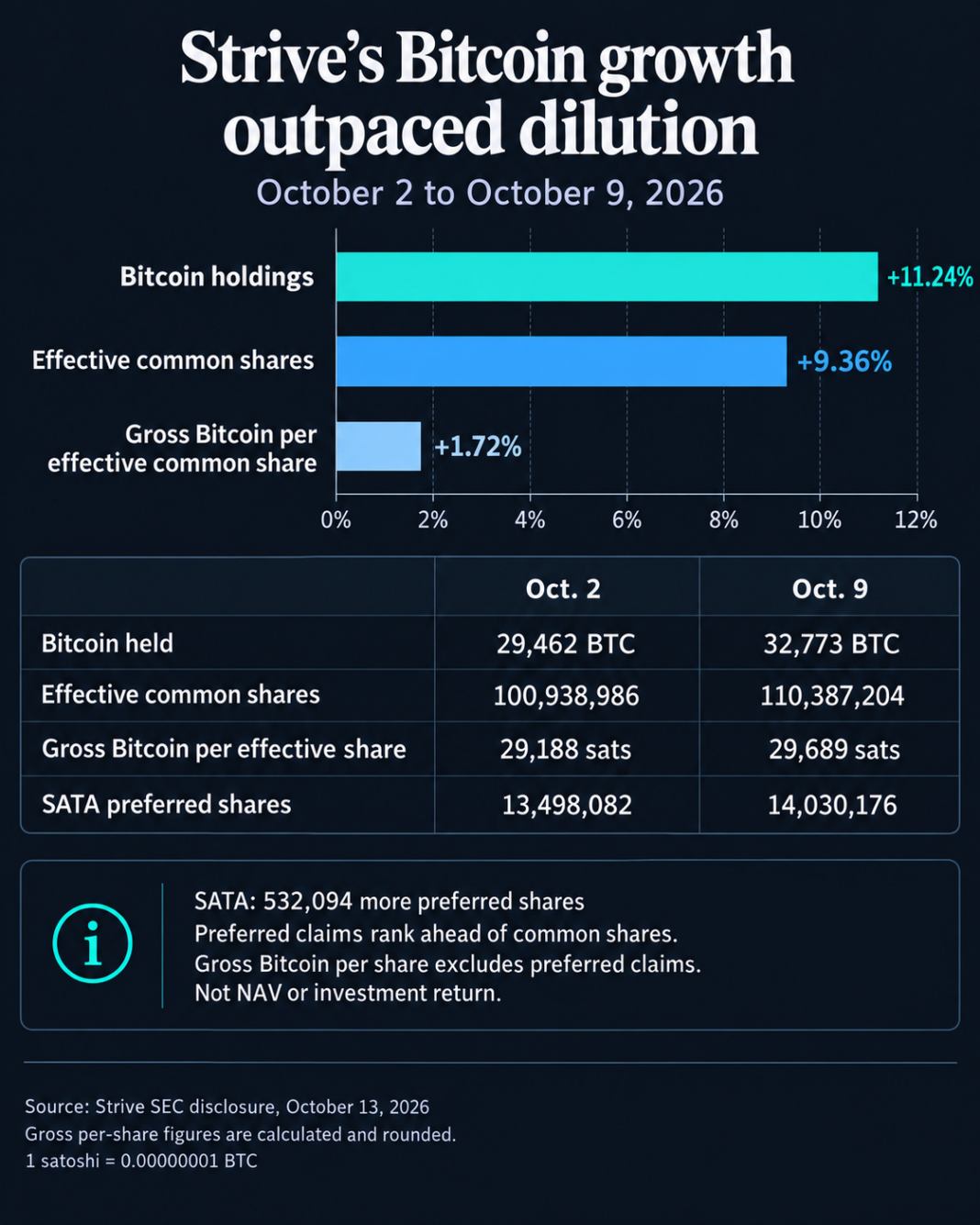
Strive, a Bitcoin treasury company, bought roughly $280 million of Bitcoin during Oct. 5–9 while increasing its cash balance, even as Strategy directed far more capital toward preferred-share repurchases than new coins. The divergence shows why Strategy’s weekly purchases provide only part of the picture of corporate Bitcoin demand.
For Strive’s common shareholders, the purchase delivered a smaller change than the headline amount suggests. Bitcoin holdings grew 11.24%, but effective common shares expanded 9.36%. Gross Bitcoin per effective common share increased about 1.72%, before accounting for preferred claims.
The Bitcoin treasury company’s Oct. 13 SEC disclosure reported purchases of 3,311 BTC at an average of approximately $84,500, including fees and expenses. Multiplying that rounded average by the coins acquired implies spending of about $279.8 million.
Strategy’s Oct. 12 update covered Oct. 5–11, two days beyond Strive’s reporting window. It reported 250 BTC purchased for $21.5 million and $192.4 million spent repurchasing STRC preferred shares.
Strive’s larger treasury translated into a modest per-share gain
Strive’s Bitcoin holdings rose from 29,462 on Oct. 2 to 32,773 on Oct. 9. Over the same comparison, effective common shares increased from 100,938,986 to 110,387,204. The company defines that denominator as its Class A and Class B common shares combined.
| Strive measure | Oct. 2, 2026 | Oct. 9, 2026 |
|---|---|---|
| Bitcoin held | 29,462 BTC | 32,773 BTC |
| Effective common shares | 100,938,986 | 110,387,204 |
| Gross Bitcoin per effective common share | About 29,188 satoshis | About 29,689 satoshis |
| Cash and cash equivalents | $284.7 million | $310.3 million |
A satoshi is one hundred-millionth of a Bitcoin. The per-share figures divide the company’s holdings by its effective common-share count. The gain measures gross treasury exposure, not net asset value or an investment return.
Class A shares rose by 9,461,103 while Class B shares fell by 12,885, producing a net common-share increase of 9,448,218. The reported counts include shares sold through the cutoff that would be issued the following business day.
The distinction has mattered before. CryptoSlate’s earlier Strive dilution coverage showed how a growing treasury could coincide with less Bitcoin per effective common share. This time, Bitcoin growth exceeded common-share growth, although the resulting improvement was far smaller than the increase in total coins.
Strive’s cash and cash equivalents also rose by $25.6 million during the comparison. It retained 505,000 STRC shares, whose fair value moved from $50.202 million to $50.328 million. That preferred-stock investment sits separately from cash and Bitcoin.
In an Oct. 13 post, Strive CEO Matt Cole said $208 million in warrants had been exercised, with about 15.3 million remaining. The SEC ledger does not allocate the Bitcoin purchase across warrant proceeds, common-share sales, preferred issuance and other cash movements.
Shares underlying traditional warrants fell from 23,249,706 to 15,255,900. The filing says exercises require payment of an exercise price, but does not establish that the entire decline generated paid exercise receipts. Its assumed fully diluted share count rose from 103,714,772 to 113,116,098. That second denominator includes options and unvested employee awards alongside effective common shares, while still excluding traditional warrants. The 1.72% calculation above uses effective common shares.
Preferred claims shape the issuers’ capital choices
Strive’s SATA preferred shares increased from 13,498,082 to 14,030,176, a net addition of 532,094, or about 3.94%. That change matters separately from dilution of common shares.
Under SATA’s disclosed terms, the preferred stock ranks ahead of both common classes for dividends and liquidation distributions. Its stated amount is $100 per share, and its liquidation preference is subject to adjustment. A gross Bitcoin-per-common-share calculation does not subtract those senior claims.
Strive’s separate Oct. 13 filing maintained a 13% annual SATA dividend rate for periods commencing Nov. 1. At that rate and the $100 stated amount, the additional 532,094 shares would carry approximately $6.9 million of annualized dividends if the incremental shares and rate persisted.
The same filing formalized a minimum price of $100 for future company sales of SATA, before discounts, commissions, fees and expenses. That restriction concerns future issuance.
Strive had already announced an optional SATA repurchase program. The new ledger shows a higher ending preferred-share count, but net outstanding shares cannot establish whether offsetting repurchases occurred.
Strategy supplied an explicit funding split for its Bitcoin buying. It sold 125,183 MSTR common shares for $21 million in net proceeds, which financed $21 million of the purchase. Another $0.5 million came from USD Cash.
Its 250-BTC acquisition brought holdings to 848,250 BTC. The average purchase price was $86,194, including fees and expenses.
Separately, Strategy repurchased 1,932,145 STRC shares for $192.4 million and reported no MSTR common-share repurchases during Oct. 5–11. It had $354.8 million of preferred repurchase authorization remaining.
Strive’s accumulation contrasts with Strategy’s buyback allocation. The two updates show different uses of capital, making Strategy’s spending choices an incomplete gauge of other treasury companies’ marginal purchases.
The common-holder mechanisms also differ. Issuing common stock expands the denominator over which treasury assets are measured. Repurchasing preferred shares addresses claims ahead of common equity while using capital; it does not directly shrink the common-share denominator or add Bitcoin.
Strategy’s cash pools reinforce the distinction. As of Oct. 11, it held a $4.88 billion USD Reserve intended to support preferred dividends and debt interest, alongside $640.5 million of USD Cash for broader treasury and capital-management purposes. Treating both balances as equivalent Bitcoin-buying capacity would obscure their different intended uses.
ETF withdrawals leave the next funding test open
The corporate disclosures overlapped a trading week with repeated ETF withdrawals. Farside’s completed Bitcoin ETF rows show the following daily net flows:
| Trading date | Bitcoin ETF net flow |
|---|---|
| Oct. 5, 2026 | Net outflows of $89.8 million. |
| Oct. 6, 2026 | Net inflows of $118.8 million. |
| Oct. 7, 2026 | Net outflows of $484.9 million. |
| Oct. 8, 2026 | Net outflows of $244.1 million. |
| Oct. 9, 2026 | Net inflows of $21.1 million. |
These are net fund flows, whereas the companies disclosed gross purchases. Different channels, accounting bases and reporting windows prevent subtracting the corporate purchases from ETF withdrawals to produce a market-wide demand balance.
Subsequent disclosures will determine whether Strive can replenish cash while adding Bitcoin and limiting dilution, and whether Strategy allocates more capital to coins or preferred repurchases. For common shareholders, Strive’s 1.72% gain in gross Bitcoin per effective common share is the measurable result. How that translates into residual value also depends on preferred claims and the cash needed to service them.