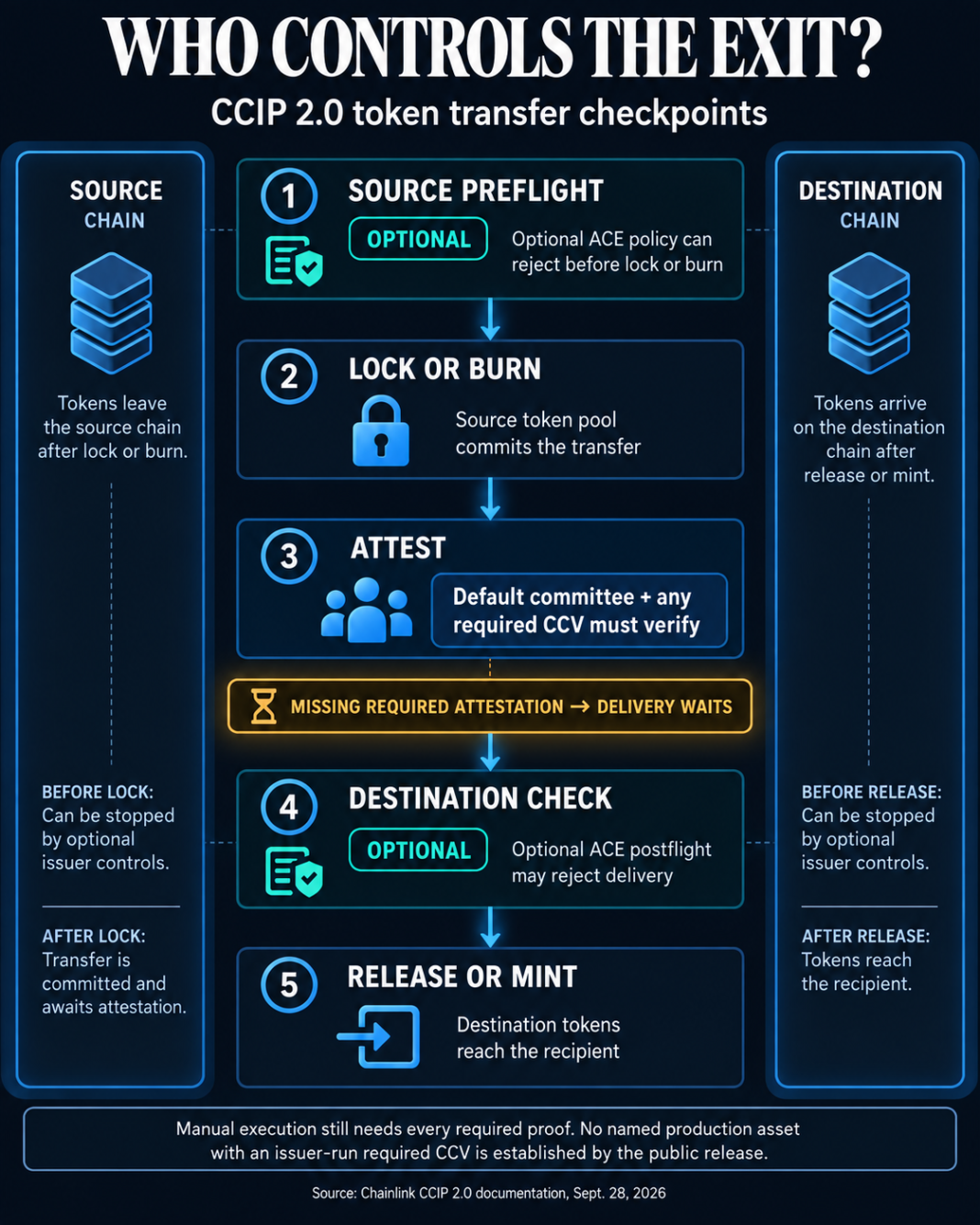
Chainlink’s CCIP 2.0 lets a token issuer require an additional verifier before tokens finish moving from one blockchain to another. A sending pool may already have locked or burned the tokens when that check becomes decisive: without the verifier’s attestation, the receiving chain cannot release or mint them.
Announced on Sept. 28, the feature adds optional Cross-Chain Verifiers (CCVs) alongside CCIP’s default Committee Verifier. An issuer or third party can operate one and make its approval a condition of delivery.
That gives the operator’s rules and uptime a direct role in a holder’s exit path. Chainlink’s launch material does not identify a named production asset and lane using an issuer-run required CCV, so the mechanism is not evidence of a holder’s transfer being blocked.
The point where a transfer can wait
CCIP’s OnRamp assembles the applicable verifier requirements of a token transfer, and the token pool locks or burns the tokens. The OnRamp then records the message for offchain verifier services.
Those services watch the source event, apply their finality and verification rules, and publish attestations tied to the message ID.
On the destination chain, CCIP’s OffRamp checks the required attestations before the pool releases or mints tokens. Its checks draw on the lane and token-pool settings and, when a receiver contract is involved, that receiver’s requirements.
Sender preferences can add to the source-side verifier set. A token-only transfer has no receiver callback whose verifier preferences must be checked. This sequence places the lock or burn before verification and the destination release after it.
A source transaction may have succeeded while destination delivery remains pending, so Chainlink says all required CCVs must return valid results before execution proceeds. Its trust model warns that an unresponsive verifier can stall every message requiring its attestation.
If an issuer runs such a verifier and makes it required for its token pool, the issuer’s service becomes one of the parties able to delay completion. A third-party operator would create a similar dependency under that operator’s control.
That is a control the design permits, not evidence that an issuer has deliberately blocked a holder’s transfer.
Chainlink says the default Committee Verifier comprises 16 independent node operators, with additional CCVs sitting alongside that baseline.
An issuer or application choosing one gains another check but must also assess who operates its contracts and offchain service, what rules that service applies, and whether it stays available.
Chainlink assigns external CCV operators responsibility for implementation, maintenance, and uptime. The key question for a holder is which attestations are mandatory for this token on this route, and who can produce each one.
What a holder can do when delivery stops
Execution on the destination chain is permissionless once every required proof exists and any optional verifier quorum has been met.
Chainlink’s default executor normally submits the transaction, but anyone can submit it, including through the manual execution path. Changing the executor or paying destination-chain gas does not waive a missing required CCV attestation. The OffRamp still checks the proofs before releasing or minting tokens.
The recovery path depends on where a message stopped. If the required attestation has not been assembled, the destination message can remain UNTOUCHED, meaning no execution has been recorded. If a submitted destination attempt fails inside the OffRamp’s protected path, it can be marked FAILURE.
Chainlink says a failed attempt can be retried after the underlying problem is fixed. Its default executor retries failures within a configured window currently set at eight hours, and that limit describes the automated service.
A holder has a usable manual route only after the necessary proofs are available and any destination-side failure is fixed. The manual execution guide describes how to inspect verifier status and execution state, including cases where the indexer has not collected an external verifier’s result.
Chainlink’s published manual execution route does not specify a general automatic cancellation, refund, or return of source-chain tokens when a required verifier never attests. Any issuer-specific remedy would depend on that asset’s arrangements.
On EVM chains, a configured Chainlink Automated Compliance Engine hook can reject an outbound transfer before the source pool locks or burns anything. That preflight failure reverts the source transaction.
A separately configured destination postflight hook can reject release or mint after the source-side transfer has started, leaving the tokens undelivered until the policy condition is resolved and execution is retried. The ACE integration guide describes these as distinct, optional configurations.
A live release, with deployment questions
Chainlink’s mainnet directory lists supported networks and tokens, but a listing does not show whether a given production lane requires an issuer-operated verifier or has enabled a destination ACE gate. Nor does a partner announcement or an earlier asset migration establish those settings.
Without the token pool, route, and verifier configuration, this new power cannot be attributed to the issuer of a named asset.
The release separately offers faster-than-finality transfers. Full source-chain finality remains the default, while the faster option can expose a transfer to duplicate destination execution after a deep enough reorganization, according to Chainlink’s FTF guide.
Other required CCVs may apply their own reorganization rules, but that speed choice does not change the need for required attestations.
CCIP 2.0 gives issuers a stronger way to set cross-chain delivery conditions. For holders, the essential questions are which checks apply to their asset, who controls them, and what remedy exists if one cannot be completed after the transfer starts.