A Bank of Italy study found that stablecoin-based remittances did not offer a systematic cost or speed advantage over traditional payment channels, as fiat on- and off-ramp frictions accounted for most costs and transfer delays.
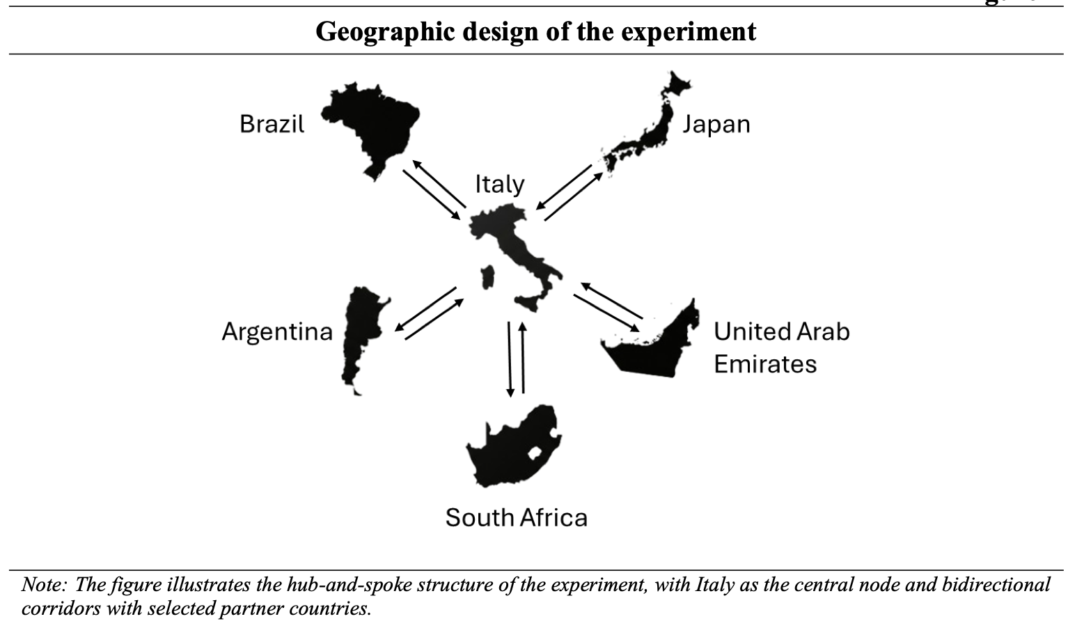
Researchers tested 200 USDC (USDC) remittances across 10 bidirectional payment corridors linking Italy with Brazil, Argentina, Japan, the United Arab Emirates and South Africa, comparing end-to-end costs and settlement times with traditional remittance services. They found that exchange fees and currency conversion made up most of the cost, while blockchain transaction fees represented only a small share.
Geographic design of the remittance experiment. Source: Bank of Italy
Across the stablecoin remittances examined, total costs ranged from 0.3% to nearly 9% depending on the payment corridor, while transfers settled in less than 20 minutes where instant payment systems were available and one to two business days where they were not.
Using the World Bank’s reported global average remittance cost of 6.65% as a benchmark, the study found stablecoin transfers were cheaper in most of the payment corridors examined. However, they were less expensive than Wise in only three of seven comparable corridors.
Related: Europe should weigh tokenized SEPA payments, Bank of Italy official says
Payment infrastructure remains critical
The study concluded that investment in domestic instant payment infrastructure could improve the competitiveness of stablecoin-based cross-border payments, finding that settlement times depended heavily on the quality of local payment rails.
The authors argued that the biggest gains may come when stablecoins no longer require conversion back into fiat currency, writing:
If stablecoins could be spent directly in the real economy, for goods and services, rents, or school fees, without reconversion into local fiat currency, the economic advantages of stablecoin-based transfers would be substantially higher.
Regulation shapes remittance efficiency
The study also found that regulatory design played a major role in determining transfer efficiency. The authors said prohibitionist regulatory regimes failed to fully suppress stablecoin demand and instead pushed users toward offshore platforms and other unregulated channels, while overly restrictive frameworks increased operational complexity for retail users.
The findings come as the European Union has implemented its Markets in Crypto-Assets (MiCA) framework and the United States has enacted the GENIUS Act, two regulatory regimes that govern crypto assets and payment stablecoins, respectively.
The stablecoin market has grown to about $307 billion, up roughly 16% over the past year, according to DefiLlama data.
Magazine: A quantum roadmap would push Bitcoin much higher: Charles Edwards