Fidelity Digital Assets has pushed back against concerns that Bitcoin’s long-term security will deteriorate as mining rewards decline, arguing in a new research report that the network’s economic incentives remain sufficient to secure the blockchain over time.
The report, authored by Fidelity research analyst Daniel Gray, reiterated the view that Bitcoin’s security depends on more than block rewards. Transaction fees, market incentives and other economic forces continue to encourage miners to secure the network and make sustained attacks prohibitively expensive, it said.
The findings challenge a longstanding criticism that each quadrennial halving weakens Bitcoin’s security by reducing the issuance of new coins. Critics argue that declining block rewards could eventually erode miners’ incentives unless transaction fees grow enough to offset the shortfall.
The issue has become one of the most closely watched long-term questions surrounding Bitcoin (BTC), whose fixed supply schedule gradually reduces new issuance until block subsidies eventually disappear. Whether transaction fees and other incentives can sustain network security remains a central debate among developers and market participants.
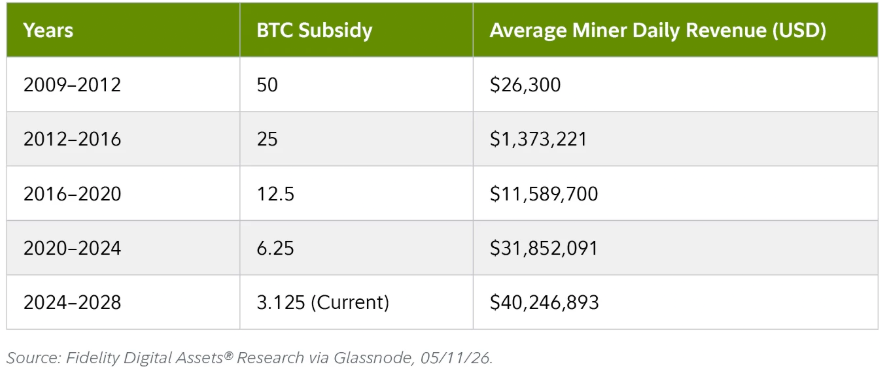
Since April 20, 2024, Bitcoin miners have received a subsidy of 3.125 BTC for each block they mine, down from 6.25 BTC during the previous halving cycle. However, Gray argued that lower issuance has not translated into weaker incentives for miners because Bitcoin’s rising price has more than offset the decline in block rewards.
He pointed to the growth in average daily miner revenue, which increased from roughly $26,300 during Bitcoin’s first halving cycle to more than $40.2 million today. “Despite declining issuance, miner incentives — and by extension, network security — historically strengthened alongside Bitcoin’s price,” Gray wrote.
Bitcoin’s average daily miner revenue has increased substantially across halving cycles. Source: Fidelity Digital Assets
Related: Nvidia’s $20 billion debt boom reinforces Bitcoin miners’ AI pivot
Public Bitcoin miners face mounting financial pressure
While Fidelity argues that Bitcoin’s long-term incentive structure remains intact, many publicly traded mining companies continue to face near-term financial pressure. Some industry analysts have described the current environment as one of the most challenging on record, citing lower mining rewards, rising costs and growing competition.
In response, several miners have diversified into artificial intelligence and high-performance computing, leveraging existing power infrastructure and data center assets to meet growing demand for AI workloads rather than relying solely on Bitcoin mining.
A recent report by VanEck estimated that publicly traded miners could require up to $50 billion in additional capital to fully transition to AI infrastructure, underscoring the scale and cost of the shift.
Public miners face a large funding gap in realizing their AI ambitions. Source: Miner Weekly
“A Bitcoin mine can run with relatively simple buildings, modular infrastructure and ASIC fleets that tolerate fast curtailment,” Blocksbridge Consulting wrote in a recent Miner Weekly publication. “AI and HPC facilities require higher standards for uptime, cooling, electrical redundancy, networking and customer support.”
Related: Crypto Biz: Is AI the exit strategy for miners?