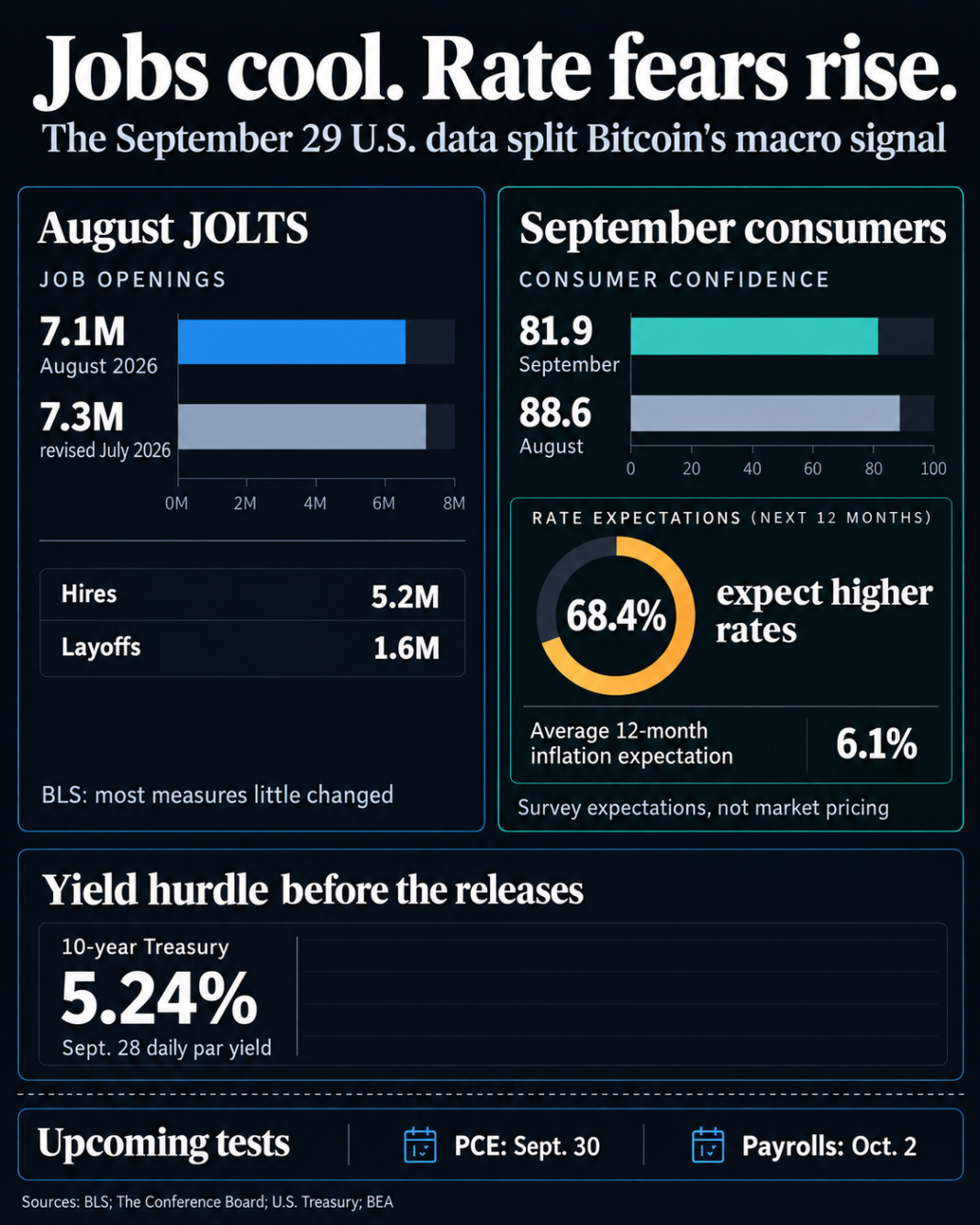
US job openings cooled modestly in August, but September households grew more worried about inflation and interest rates. That split left Bitcoin investors with only part of the case for easier financial conditions after Sept. 29 releases.
Bitcoin registered an intraday low of $82,775.94 on Tuesday, and a reclaim of the $84,000 support level depends more on the path of yields and new demand than on a single vacancies report.
The labor and consumer surveys describe different pressures, and neither establishes the cause of Bitcoin’s price.
Job openings ease as rate worries rise
According to the Bureau of Labor Statistics, August job openings were little changed at 7.1 million, down from a revised 7.3 million in July. The July figure was revised upward by 64,000, making the comparison less dramatic.
Hires changed little at 5.2 million, quits were unchanged at 3.1 million, and layoffs and discharges were essentially unchanged at 1.6 million. The report points to somewhat softer demand for workers, and a slower labor market may ease pressure on interest rates, while a sharp deterioration could also hurt risk appetite.
The Conference Board’s September consumer confidence index fell to 81.9 from 88.6 in August. Its Expectations Index, based on consumers’ short-term outlook for income, business and labor conditions, declined for a third consecutive month to 63.6. Respondents also described the current job market less favorably.
Their rate and inflation answers ran counter to a simple “soft jobs, lower yields” interpretation. The share of consumers expecting higher interest rates over the next 12 months rose 5.2% to 68.4%.
Average expected inflation over that horizon rose to 6.1%, while the median rose to 5.1%, and both increased 0.3% from August.
The survey was conducted Sept. 1-23, a period that included the Federal Reserve’s Sept. 16 rate increase to a 3.75%-4.00% target range, which provides context for consumers’ answers.
The latest posted Treasury daily par yield curve data put the 10-year rate at 5.24% and the two-year at 4.92% on Sept. 28. The observation precedes Tuesday’s releases, so it does not measure a bond-market reaction to them.
Treasury securities offered substantial yields while Bitcoin itself pays no coupon, so softer hiring would help Bitcoin more if subsequent inflation data gave yields room to fall.
ETF demand and the next economic tests
The Sept. 28 US-traded spot Bitcoin ETF posted a positive net inflow of $31 million, smaller than each of the five preceding completed sessions, according to Farside Investors.
Stronger inflows in completed sessions would show buyers returning even while yields remain elevated. If inflows stay subdued, a lower-yield backdrop may matter more for any sustained recovery above $84,000.
Neither the prior day’s ETF total nor a live Bitcoin quote shows how investors responded to Tuesday’s economic releases.
The Bureau of Economic Analysis is scheduled to publish August personal income and outlays on Sept. 30, including PCE inflation data, and the September employment report follows on Oct. 2.
A cooler inflation reading alongside slower but orderly hiring would strengthen the case for lower Treasury yields. If yields then decline and completed ETF flows improve, Bitcoin could face less competition from interest-bearing assets and firmer evidence of new demand.
A hot inflation print or persistently high yields would weaken that case, even if payroll growth slows. A much sharper jobs slowdown could raise its own risks.
For now, the labor data show moderation, while the consumer survey shows anxiety about prices and rates. Bitcoin’s route back above $84,000 turns on whether forthcoming data and market prices resolve that tension, and whether buyers show up in completed ETF flows.