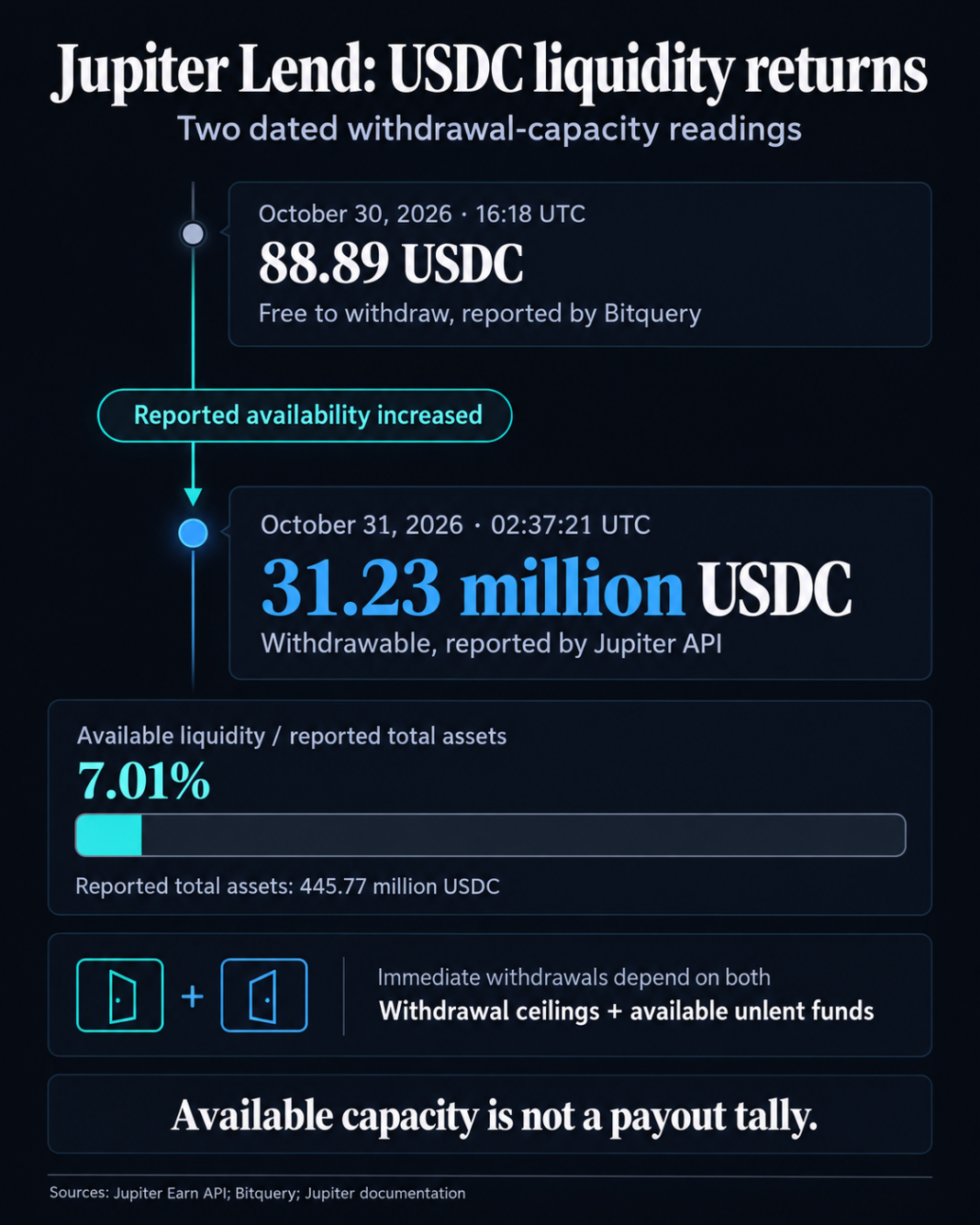
Jupiter Lend’s reported USDC withdrawal liquidity stood at about 29 million USDC in a 09:25:56 UTC reading on Oct. 31, easing the immediate cash constraint at Jupiter’s lending product after near-zero availability the previous afternoon.
Bitquery reported that only $88.89 of USDC was free to withdraw at 16:18 UTC on Oct. 30, against $416 million owed to Jupiter Lend’s USDC savers. The October 31 reading indicates a substantial increase in reported funds available for exits.
An earlier API snapshot captured the initial overnight recovery:
The official Earn API reported about 31.23 million USDC withdrawable, with its liquidity data last updated at 02:37:21 UTC on Oct. 31. It also reported approximately 445.77 million USDC in total assets. Available withdrawal liquidity therefore represented about 7.01% of those assets.
By 09:25:56 UTC, the API showed about 29 million USDC withdrawable against 443 million USDC in total assets. Available funds were about 6.6% of total assets. These balances measure withdrawal capacity; Bitquery’s amount owed to savers describes depositor claims.
The improvement marks partial recovery in withdrawal capacity.
Why withdrawal limits do not guarantee cash
Jupiter’s documentation describes two constraints on immediate withdrawals: dynamic ceilings that control how quickly funds can leave, and the liquidity actually available. The latter consists of assets that have not been lent to borrowers.
The ceilings adjust over time, limiting the pace at which supplied funds become eligible for withdrawal. Even when a ceiling permits a withdrawal, the pool must have enough available liquidity to meet it. A larger allowance therefore cannot, by itself, remove a shortage of unlent funds.
In the 09:25:56 UTC reading, the API showed about 221 million USDC in withdrawableUntilLimit, compared with 29 million USDC in withdrawable. The larger field should not be mistaken for immediately available cash. Jupiter’s mechanics documentation explains the general ceiling constraint, without explicitly defining those API field names.
For a depositor seeking a full exit, the available balance remains consequential. Jupiter says users may need to wait for borrower repayments or new deposits when most of an asset is borrowed.
The October 31 figures show more reported room for withdrawals than Friday’s near-zero reading. Sustained access still depends on the funds available as withdrawals, repayments and deposits change the pool’s balance.