Crypto exchange MEXC is withdrawing from France, marking its fourth country-level retreat since September as its new chief executive pursues an ambitious global expansion.
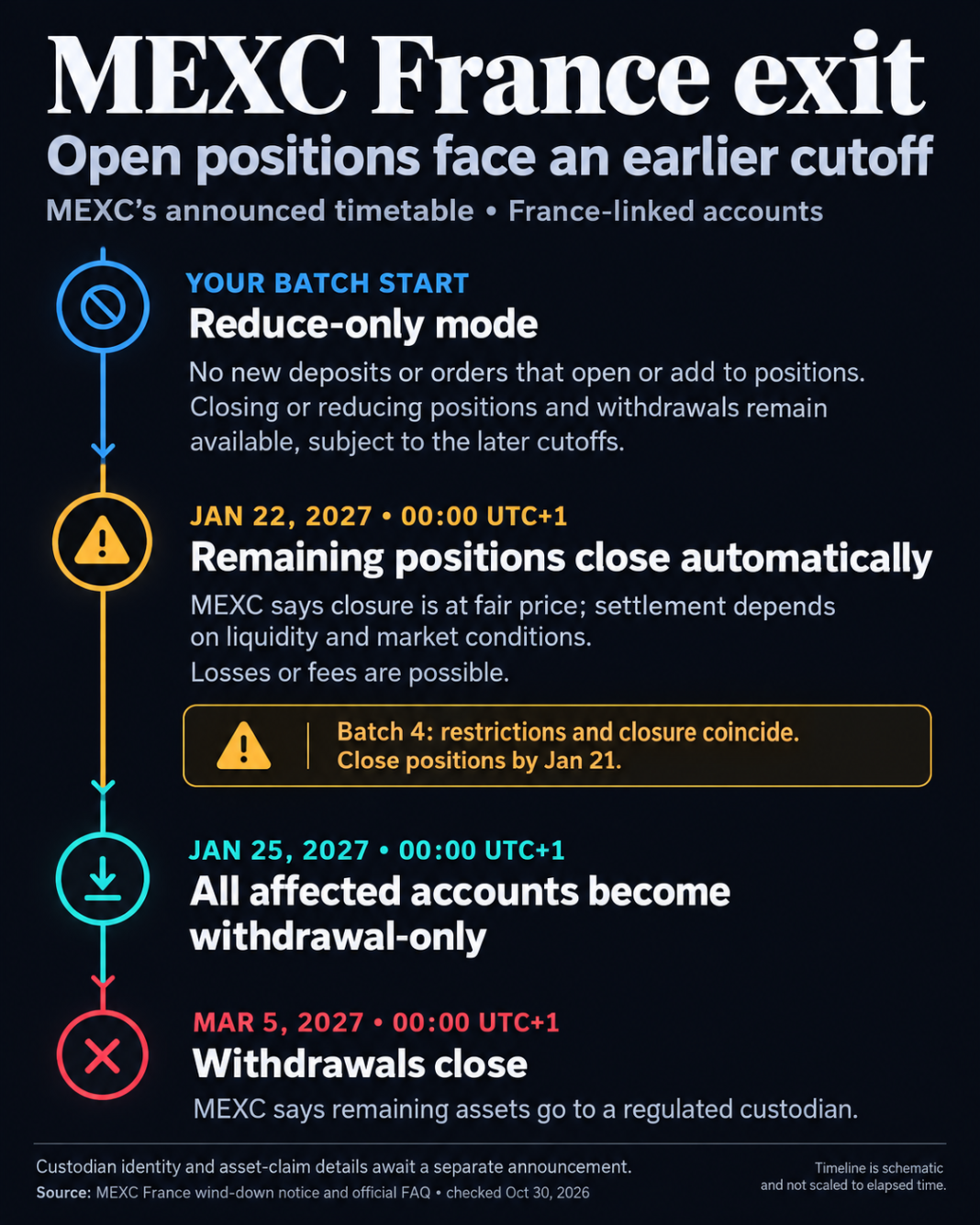
The exchange said in an Oct. 28 notice that it would gradually discontinue services to French customers, automatically close outstanding trading positions by Jan. 22, 2027, and terminate withdrawals on March 5.
The decision extends a series of market exits under CEO Vugar Usi, who is seeking to transform the platform from a cryptocurrency exchange associated with memecoin speculation into a broader trading business offering tokenized equities, commodities and prediction markets.
MEXC began the latest withdrawals with the Netherlands on Sept. 29, citing regulatory developments in the European Economic Area. It subsequently announced the discontinuation of services to customers in Russia and Belarus on Oct. 20 as part of its global compliance efforts.
The retreat from France is particularly significant because the country’s financial regulator, Autorité des Marchés Financiers (AMF), blacklisted MEXC in June 2024 for offering financial services without the required authorization.
The latest withdrawal also comes as Europe’s Markets in Crypto-Assets Regulation (MiCA) imposes authorization requirements on cryptocurrency service providers, increasing the pressure on exchanges operating without the necessary regulatory approvals.
MEXC said French customers would face restrictions in four batches beginning Nov. 18, preventing them from opening new positions or making additional deposits once their assigned restrictions take effect.
Outstanding positions will be automatically settled on Jan. 22 based on prevailing market conditions and available liquidity, potentially exposing customers to losses or additional fees.
Any assets remaining after the March withdrawal deadline will be transferred to a regulated custodian, which the exchange has yet to identify.
Meanwhile, MEXC has begun offering affected French customers referrals to EU-regulated trading platforms, although users must independently open accounts and transfer their holdings before the withdrawal deadline.
MEXC’s global ambitions face growing regulatory constraints
The market withdrawals contrast with Usi’s strategy to expand MEXC’s product offerings and establish the exchange as a retail-focused competitor across cryptocurrency and traditional financial markets.
Usi, who became CEO in April, has outlined plans to broaden the company’s historically speculation-driven business into a platform that lets users trade multiple asset classes through a single interface.
The strategy builds on MEXC’s approximately 40 million users, more than 90% of whom are retail customers, giving the exchange an established audience for new financial products.
Usi has also placed regulatory compliance and customer protection at the center of his leadership approach, emphasizing operational execution and the need to build trust among retail users.
The diversification strategy is already generating activity.
According to MEXC’s September trading report, tokenized US stock spot trading volume increased 81% month over month, while trading in AI-related tokenized equities and ETFs rose 88%.
The exchange said it now offers more than 450 stock and index futures trading pairs and over 200 tokenized US equities, alongside its RealStocks service, which provides access to more than 7,000 US stocks and exchange-traded funds.
These offerings could help MEXC capture demand from retail traders seeking exposure beyond digital assets, although recent withdrawals have narrowed the number of jurisdictions where customers can access its services.
The company is also exploring external partnerships to strengthen its international business.
Earlier this month, MEXC disclosed discussions with Payward, the parent company of US cryptocurrency exchange Kraken, about a potential collaboration involving market access, trading infrastructure, and liquidity.
The companies identified complementary strengths, with MEXC emphasizing retail trading and access to crypto and traditional financial products, while Payward brings established financial infrastructure and a significant US market presence.
The discussions remain exploratory, and neither company has announced a definitive agreement or operational integration.