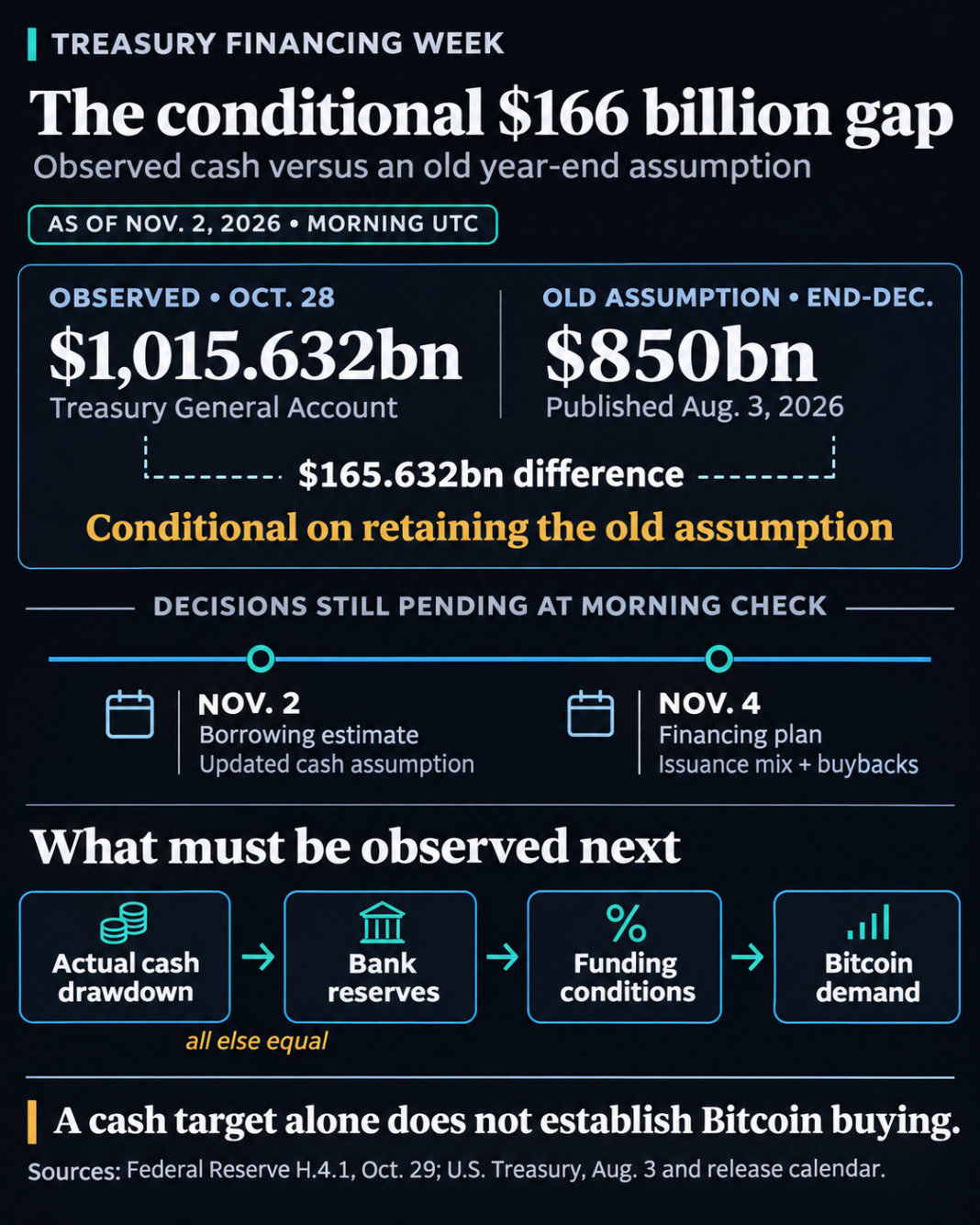
Treasury’s financing decisions this week will test whether a possible year-end cash drawdown can ease Bitcoin’s funding backdrop. The government held about $1,016 billion at the Federal Reserve on Oct. 28, inside the range it had anticipated for late October.
The potential relief depends on the cash assumptions Treasury updates in its Nov. 2 borrowing estimates and the issuance and buyback plans due Nov. 4. A drawdown can return reserves to banks, all else equal, while financing the government continues to place demands on cash and intermediaries.
Bitcoin’s price was about $77,865 in CryptoSlate’s market data at 10:41 UTC on Nov. 2, below $80,000. At the Nov. 2 morning check, Treasury’s release calendar still displayed August estimates and listed both November announcements as forthcoming.
The $166 billion gap and bank reserves
The Fed’s Oct. 29 balance-sheet release put the Treasury General Account (TGA), the government’s operating account at the central bank, at $1,016 billion on Wednesday, Oct. 28.
Treasury’s Aug. 3 borrowing forecast assumed an $850 billion cash balance at the end of December alongside $628 billion of privately held net marketable borrowing in the fourth quarter. Subtracting that old cash assumption from the October observation produces a gap of about $166 billion.
That comparison describes how far the account would have to fall to reach the August assumption.
A trillion-dollar account was also part of Treasury’s earlier planning. Its Aug. 5 refunding statement anticipated a late-October peak of $1.05 trillion, plus or minus $50 billion, citing the large outflows it expected around that time. That estimate described a cash buffer for upcoming payments. The Oct. 28 observation was inside that range, although a single observation cannot establish the eventual peak.
This makes the revised year-end assumption central. Retaining the old cash level would preserve a route to a substantial decline from the October observation. Raising the assumption would leave less room for that decline; lowering it would leave more.
The Nov. 2 release addresses the aggregate borrowing estimate and cash assumptions. The Nov. 4 refunding statement and schedules will add the instrument mix and buyback plans.
The reserve channel starts with payment accounting. As the Fed explains, Treasury payments move money from its account into a depository institution’s account at the central bank, either for the bank itself or for a customer. All else equal, that increases bank reserves.
Flows in the opposite direction absorb reserves through the same channel. Taxes paid into Treasury’s account and private purchases of government debt move funds toward the TGA. A projected cash drawdown therefore has to be understood alongside the financing and receipts that replenish the account. The realized net change in the account already reflects those incoming and outgoing cash flows.
The October data also show why Treasury cash cannot explain the entire reserve picture. Bank reserves averaged $2,894 billion in the week ended Oct. 28, down $69 billion from the previous weekly average. Over the same weekly-average comparison, the TGA rose $48 billion, other deposits increased $16 billion and total factors supplying reserves fell $1 billion.
These weekly averages describe a different measurement from the $1,016 billion Wednesday cash balance. Combining that point-in-time TGA figure with the weekly reserve change would blur the timing of the comparison.
Fed asset movements and shifts in other liabilities can also alter the result. A falling TGA would support reserves through one channel, but the realized reserve total and the behavior of short-term funding markets would determine whether conditions actually became easier.
Issuance shapes the Bitcoin funding test
Different types of borrowing place different demands on dealers and their clients. An Oct. 30 Fed staff study found that issuance increases dealer inventories and demand for client financing, with larger estimated balance-sheet effects from coupon securities, such as notes and bonds, than from bills.
Inventories generally unwind within several days, while financing demand can persist after the securities have moved to clients. The study’s main regression sample ran from January 2016 through June 2025.
Buybacks of outstanding Treasury debt can ease selected inventory burdens while the government continues to raise money. The department’s Aug. 19 announcement increased the maximum size of long-end liquidity-support operations from $2 billion to at least $4 billion per operation, effective Sept. 9 through Nov. 4. Treasury said it would provide more information about future sizes at the November refunding.
Those amounts are operation ceilings, not completed purchases. Treasury also says buybacks are not expected to significantly change privately held net marketable borrowing because new issuance replaces the securities bought back.
For Bitcoin, the relevant question is whether the combination leaves funding easier and investors more willing to carry risk. A lower cash assumption can coexist with issuance demands that keep intermediaries busy. The borrowing total, maturity composition and settlement schedule therefore need to be read together.
The proposed link to Bitcoin is a financial-conditions hypothesis. A 2023 IMF working paper found that Fed tightening reduced a broad crypto-price factor through investor risk-taking. Treasury cash management differs from a Fed policy change.
The useful test has several observable steps. A revised cash assumption would update the projected year-end balance. Subsequent balances would show whether the drawdown occurred. Stabilizing reserves and calmer repo funding, where securities are financed against collateral, would strengthen the case that the cash movement helped the wider funding backdrop.
For the demand side of that hypothesis, sustained net inflows into Bitcoin investment products and stronger spot buying alongside easier funding would be consistent with the relief thesis. Reserve relief without that demand would leave the price argument incomplete.
A higher cash target, continued reserve declines or persistent financing pressure would weaken the relief thesis. So would weak Bitcoin demand after funding conditions improved.